

Facebook
Twitter
LinkedIn
There are moments when the world feels simultaneously small and yet impossibly distant.
Small, because we are more connected than ever, with news, images, and lived realities crossing borders in seconds. And distant, because the weight of those realities is not necessarily being shared equally.
Across the world, that contrast feels particularly stark now in healthcare leadership.
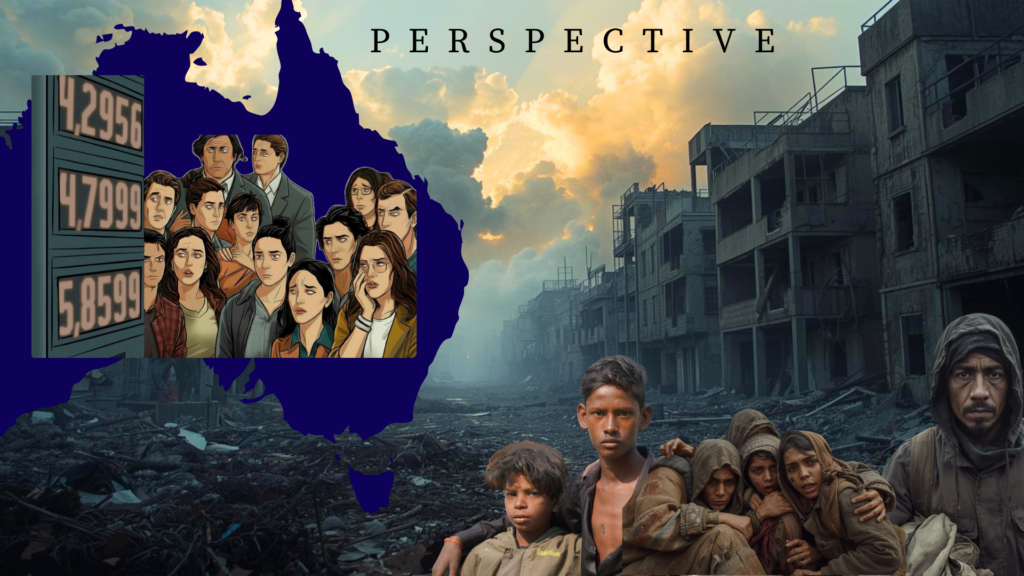
In Australia, conversations are frequently grounded in the rising petrol prices, increasing cost of living, and the quiet strain of health system uncertainty. Yes, these are real concerns, shaping how people live, work, and access care.
And yet, just beyond our shores in war affected regions, the same issues are carrying a very different meaning. Not of inconvenience. Not of cost. But of survival, and the continuity of life itself.
This is not a comparison designed to diminish one experience over another. Rather, it is an invitation. To pause, to reflect, and to widen the lens through which we understand pressure, resilience, and leadership in today’s world. Because in times like these, perspective, becomes more than just a choice. It becomes a leadership responsibility.
A World Under Pressure
War continues to redraw the edges of health systems, with global conflicts displacing millions and placing extraordinary strain on healthcare infrastructure. The humanitarian consequences alone continue to test the limits of medical neutrality, workforce resilience, and access to care.
Fuel instability, intensified by geopolitical tensions and supply disruption, is quietly but directly impacting healthcare delivery. Ambulance fleets are costing more to run. Supply chains are becoming less predictable. Remote and regional services are feeling the pressure first, and the hardest.
Layering onto this the accelerating effects of recent climate-related disasters —the floods, the fires, the cyclones, and suddenly “business as usual” is a concept that feels rather unrealistic.
Workforces are tired, but still showing up. Patients are more informed, but more anxious. Technology is advancing faster than governance frameworks can keep pace. We are living in a state of continued crisis, and what seems to be perpetual instability.
The Quiet Global Convergence
What’s striking though is how similar these challenges really may be, across borders.
Step into any health system today, from Brisbane to Birmingham, Toronto to Taipei, and the same undercurrents are there.
In publicly funded systems, leaders are grappling with sustainability and access. In private systems, it’s affordability and value. In emerging economies, it’s infrastructure and workforce migration. Psychosocial safety, workforce retention, digital transformations – the list goes on.
Even artificial intelligence, tele-health services, and remote care models are no longer just emerging, they’re becoming well and truly embedded. But in doing so, their integration is starting to expose a whole new paradox. Technology promises efficiency, but is often introducing complexity. It promises access, but is seen to be deepening inequity. It promises clarity, but is starting to erode trust.
Different contexts, different realities and varying challenges. But the same questions that underpin them.
How do we continue to deliver care that is safe, equitable, and human? Without exhausting the people who provide it?
And beneath it all, the deeper question:
What does good healthcare leadership actually even look like now?
Leaders who build trust across clinicians, administrators, patients, and policymakers may now be the ones who can actually move systems forward. Not because they will have all the answers, but because people may be more willing to navigate this uncertainty with them.
Clinical expertise, financial acumen, operational excellence; these remain essential. But they may no longer be sufficient. Because the differentiator is increasingly requiring a greater perspective, a collective approach and a more “relational skillset”:
- Can we hold difficult conversations without fracturing loyalties?
- Can we listen without immediately needing to fix?
- Can we sit with competing truths without rushing to rationalise them?
- Can we justify focusing on “inconveniences” over more dire impacts occurring elsewhere?
These are difficult reflections requiring complex skillsets, with no easy solutions.
They are also perhaps the new system-critical capabilities that will become essential for healthcare leaders in balancing compassion with accountability in an increasingly connected global healthcare landscape.
The Emotional Load of Leadership
This is something we never really talk enough about, whether in local systems or global.
Behind every workforce strategy, every board paper, every reform agenda, there are leaders carrying an emotional burden that doesn’t make it into formal reporting. A burden made up from the quiet weight of knowing their staff are exhausted, having to make decisions with incomplete information and struggling to balance compassion with accountability.
This is primarily because there has always been a misconception that strong healthcare leadership requires boldness, confidence and certainty, above all else.
But it seems that in an increasingly fractured world, we’re beginning to discover more and more that strength in leadership arises from a willingness to reflect and compare. That it may rest with those individuals who are unafraid to say:
“We don’t have all the answers yet.”
“This is harder than we anticipated.”
“We need to rethink how we’re doing this.”
“Maybe we should look at the bigger picture.”
Not as a loss of authority, but as an invitation to collective impact and broader intelligence. Because the complexity of modern healthcare in challenging and changing contexts, cannot be solved by individual effort alone. It requires a shared ownership and a shared incentive between systems, between jurisdictions and between regions. Perhaps even a shared perspective, one that looks at “the wood for the trees.”
For healthcare leaders then, perhaps the imperative this year could be quite simple:
To lead with a little more honesty, to listen a little more deeply, to see a little more broadly, and to prioritise what truly matters, even when that may be not what we’re used to. Because some things, like compassion and authentic leadership, need to be more carefully cultivated.
The Road Ahead
There will not be any neat resolutions any time soon.
Healthcare systems will continue to face pressure. Workforce challenges will not disappear. And technology will keep evolving faster than policy.
But there may also be something emerging now that’s quietly encouraging and promising.
Across the globe, there are a few leaders who are choosing to lead differently. More reflectively, more selflessly and more humanely.
And this change in perspective may be the most important shift of all.
Because in the end, healthcare is not just a system to be managed. It is a human endeavour to be stewarded.
And in the spaces between our strategy meetings, service demands and local priorities, perhaps there is some value then, in taking a moment, not to step away from the local leadership responsibilities, but to reconnect with why leadership matters in healthcare in the first place. Regardless of where we may happen to live and work.
Because if this moment in global healthcare is to be defined by anything, it is that of perspective and relational skills.
And this is where healthcare leadership capability must evolve. Beyond just strategy, governance, and operations, but to how we relate.
Which is why we are seeing a growing need to invest in relational capability as a core leadership skill, not an optional extra.
Programs like AIHE’s new Relational Skills for Healthcare Leaders Courses are not about softening leadership.
They are about strengthening it, expanding perspectives and equipping leaders to:
- Navigate difficult conversations with clarity and respect
- Build trust in environments where it is easily eroded
- Lead teams through uncertainty without losing cohesion, and
- Hold complexity without defaulting to oversimplification
In an increasingly fractured world, technical excellence and isolated system improvement alone may not be enough.
The real purpose of authentic leadership may be in looking at the bigger picture, and leading more collectively.
The pressures of war, fuel instability, workforce strain, all will remain.
But so too will this opportunity we have now.
To lead with a greater awareness, a broader accountability, and ultimately, a more human-centred perspective.

