

Healthcare is not just another sector.
It is a high-stakes, human-centred system where decisions directly affect lives. Clinical expertise is not optional at the board level, it is foundational.
But we know that most doctors don’t set out to become board directors. You train to diagnose, to treat, to care. Not to sit in boardrooms reviewing risk registers or debating strategy papers.
And yet, some of the most important decisions affecting your patients are made there.
Not at the bedside. Not in the clinic. But around a table that you may never sit at.
Across Australia, health service boards carry enormous responsibility. Under frameworks like the Health Services Act 2016, and the National Health Reform Act 2011, boards are accountable for the performance, safety, and quality of healthcare organisations.
They are responsible for ensuring the health systems are safe. That risks are managed. That patients receive high-quality care. This is not just theoretical accountability, it’s real.
And at the moment, it sits mostly with directors, many of whom have never worked a night shift, have never managed a deteriorating patient at 3am, and have never had to make a life-or-death decision under pressure.
Where things start to drift
Most boards are filled with highly capable, well-intentioned people, so this isn’t about any criticism. But healthcare is different.
It’s complex, fast-moving, and deeply human. Decisions that look reasonable on paper can unravel quickly in practice.
A funding decision can stretch staffing.
A policy change can create significant unintended clinical risk.
A “minor” operational shift can ripple into catastrophic patient harm.
Without actual clinical insight at the table, these risks are often harder to see — until it’s too late.
Clinical Governance is Not Abstract. It is a Board Responsibility.
Australia’s health system has increasingly emphasised clinical governance as a core board function.Under frameworks established through the National Health Reform Act 2011, health entities are expected to deliver safe, high-quality care, with governance structures that support this mandate.
Boards are not passive overseers. They are responsible for:
- Setting the tone for safety and quality
- Ensuring effective clinical governance systems
- Monitoring patient outcomes and risk
This requires more than dashboards and reports. It requires interpretation, and that demands clinical expertise.
Why your voice matters more than you think
As a doctor, you carry something into the boardroom that cannot be taught in a governance textbook.
You understand consequence.
You’ve seen what happens when systems fail, not as data points – but as people.
You also understand nuance:
- Why a protocol works in theory but not in reality
- Where safety systems are fragile
- What frontline teams actually need to deliver care safely
That perspective has the power to change conversations. It sharpens decisions. It grounds strategy in reality. But more importantly, it builds trust with the workforce in a way few others can.
“But I’m not a governance expert…”
This is the hesitation we hear most often from medical practitioners. Doctors don’t step forward because they feel they lack the “boardroom skillset.”
But the reality is that governance can be learned. In fact, every director—clinical or not —is expected to meet the same standards of care, diligence, and accountability.
That means understanding:
- What good governance actually looks like
- How boards make decisions
- How to interpret risk, finance, and strategy
- When (and how) to challenge constructively
These are skills that can be learned. Not innate traits.
And they are entirely within reach.
Moving Beyond Tokenism: From Representation to Leadership
Having “a clinician on the board” is no longer enough.
The complexity of modern healthcare -digital transformation, workforce pressures, safety expectations – all demand clinically literate leadership at the highest level.
This means:
- More doctors serving as board directors
- Doctors chairing key committees (especially safety and quality)
- Doctors stepping into full board leadership roles, including Chair
This doesn’t diminish the value of non-clinical directors. Strong boards require diversity of expertise. But in healthcare, clinical expertise must be central —not peripheral.
Healthcare doesn’t just need more clinicians “represented” on boards.
It needs doctors who are confident, capable, and prepared to lead in those environments.
Doctors who can:
- Ask the right questions
- Translate clinical risk into strategic language
- Influence decisions at the highest level
Because if doctors aren’t helping shape those decisions, they will still be made, just without the required clinical grounding.
Clinician to Director Pathway
For medical practitioners starting to think about this path, the transition from clinician to director doesn’t happen by accident. It requires intentional development.
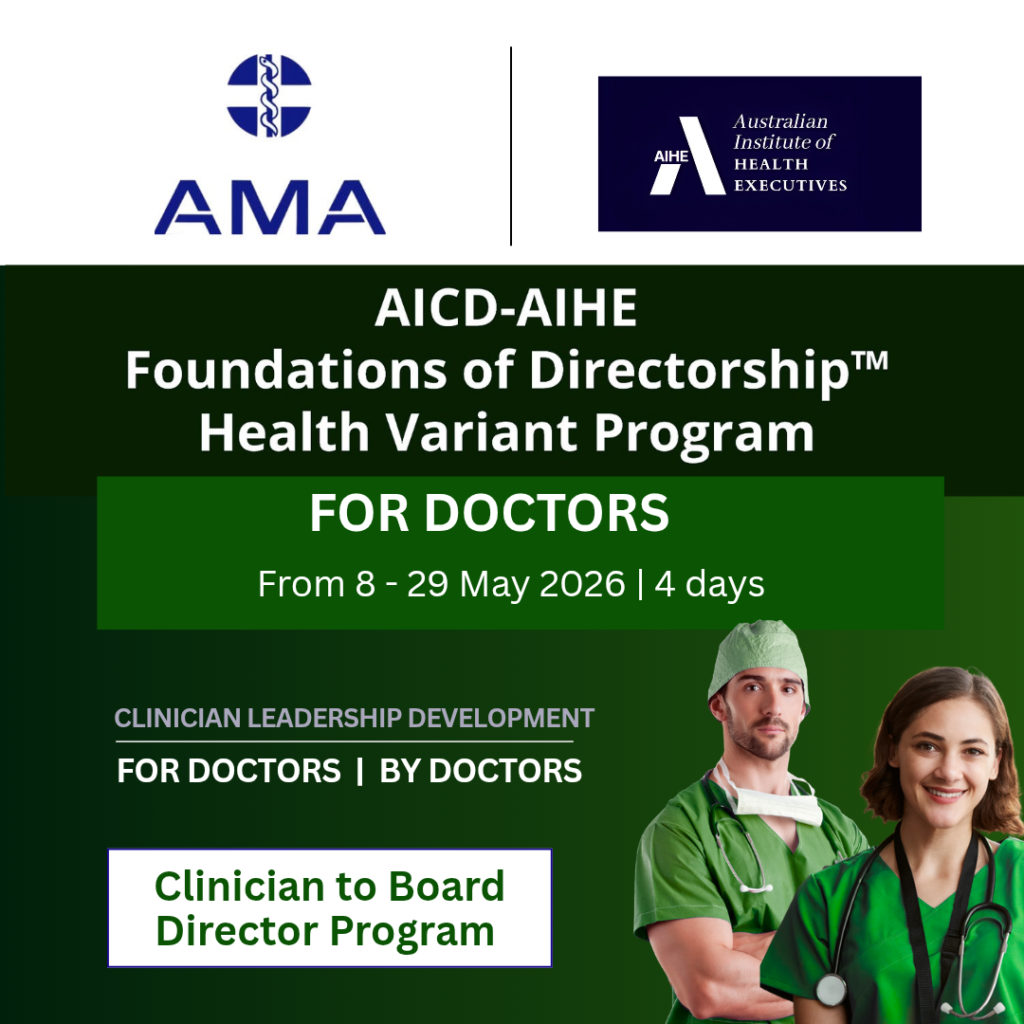
Tailored programs like the AICD–AIHE Foundations of Directorship™ Health Variant have been designed specifically with doctors in mind, to bridge the gap between clinical expertise and board-level impact.
Not to turn you into someone else. But to equip you to bring your clinical perspective into a space where it is urgently needed.
You don’t need to leave medicine to influence the system.
But you do need to step into the rooms where the real decisions are made.
Because the future of healthcare won’t just be shaped by those who deliver care,
…but by those who govern it.
Through AIHE’s partnership with the Australian Medical Association, we’re offering an exclusive opportunity for AMA Members to access our nationally recognised governance training at a reduced rate this May.
For more information about this offer and to register visit AMA Events.
If you’re a doctor who’s ready to step into leadership with confidence, now is the time.

