

Facebook
Twitter
LinkedIn
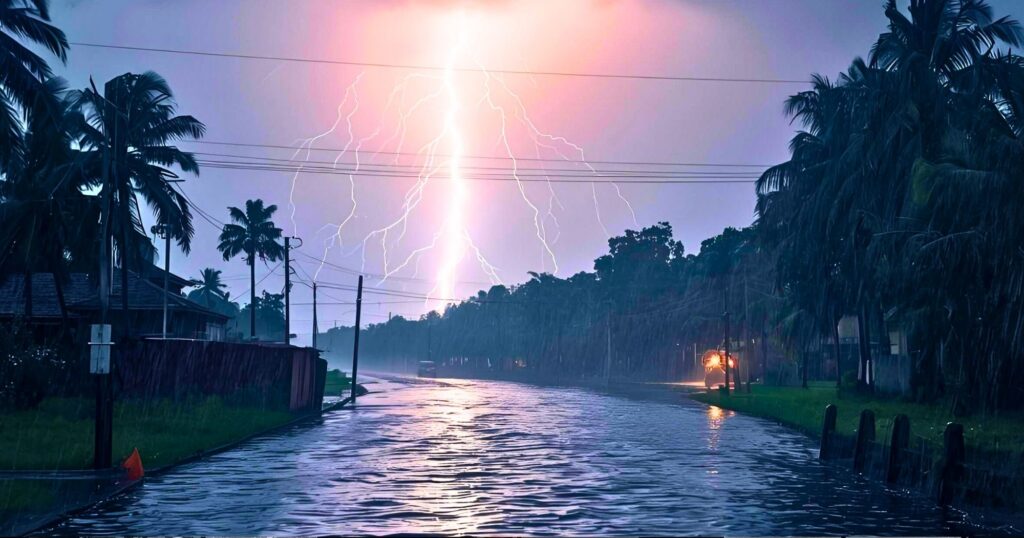
When Cyclone Ditwah struck Sri Lanka in the early hours of the 28th of November 2025, it did more than just destroy homes, roads and livelihoods.
It laid bare a truth that all health systems — whether in Sri Lanka, in Australia, or in other parts of the world — often forget until it is too late. That whilst a disaster response may at times seem to be a very technical exercise, they will always be a very moral test of leadership.
In the initial hours after Ditwah made landfall, hospitals became islands, some with patients needing urgent evacuation, cut off from supply routes and overwhelmed by the displaced. Landslides buried roads and entire communities. Electricity and communication networks collapsed. An entire nation of 22 million people, including every level of health system governance, was impacted all at the same time – the sheer scale of which Australia has never experienced apart from the COVID-19 pandemic.
And yet, amidst the chaos of such immense impact, there was something unmistakable that was clearly palpable. A quiet, steadying presence that continued unabated. It was not a single person. It was not a sophisticated disaster management protocol. It was a way of leading.
And it is there, in that particular aspect of this crisis, that the deepest lessons for Australian healthcare leaders begin.
Leadership is the first form of care
In the first 24 hours of a disaster, decision-making cannot afford to be complicated. Health leaders must move quickly – activating emergency command roles, making bed-allocation decisions on the fly, and coordinating local volunteers when official channels are cut off.
These will not be decisions based on perfect information, but out of perfect necessity.
There will be no perfect data feeds.
There will be no functioning system and no working infrastructure.
There will only be the leaders who are prepared to step forward when their communities need them.
This is not just a competence that can simply be expected to be there, even in a well resourced system, with highly developed processes. It is more a matter of character.
And in a disaster, it is this that can save lives.
Australia’s health system is advanced, well-governed and deeply resourced.
But complexity can often become a liability when a crisis hits.
Because we can forget that leadership during a disaster is less about complying with sophisticated policies, and more about the responsible courage. The courage to act early, to act locally, and to act ethically, even when conditions are unclear. People will look to you as a healthcare leader long before they look to the modern disaster management systems, the advanced policy documents or the high-tech dashboards.
If the first instinct of any system is to ask permission instead of protecting people, that system has already failed an important moral test.
When systems break, community becomes the operating theatre
One of the most compelling aspects of Sri Lanka’s disaster response was the instinctive reach toward community networks. When the formal systems broke, it’s informal networks surged. Public health midwives tracked down displaced mothers. Neighbours escorted vulnerable patients through damaged roads. Volunteers turned schools into functioning clinics within hours.
Their greatest asset wasn’t funding, technology or policy.
It was trust.
It was community, not sophisticated infrastructure, that became the real operating theatre and the real rescue effort.
This is where Australia must pay attention.
That level of community trust is not one that can simply be paid for, legislated or assembled overnight. It needs to be built through relationships, through long standing culture and an individuals’ sense of belonging to a community — especially in our metropolitan, impersonal, socially isolated and culturally diverse areas. And in a disaster, it is trust that can become an operating theatre when the actual one floods.
Australia has strong emergency capabilities, yet we can sometimes underestimate the quiet strength of communities — whether in the fast-paced city areas or in the far flung and forgotten rural areas.
If we want resilient health systems, we must invest in the relationships and social isolation challenges that can outlast any cyclone, bushfire or flood.
The humility to keep things simple
When supply chains collapse, health leaders cannot wait for the perfect national or jurisdictional solution. They must decentralise supplies, use local procurement, and lean on whatever transport routes remain open. Improvisation should not be just a workaround — it must be part of the plan.
Leaders must adopt the right mindset to use low-tech backups when digital systems fail.
In Australia, our logistics are sophisticated and usually reliable, but they are not invincible. The moral responsibility of healthcare leaders is to ensure that backup systems are simple enough to function when high-tech ones fail, no mater how sophisticated we think our systems may be.
A disaster does not reward elegance. It rewards adaptability.
Caring for the carers
We often say that healthcare workers are resilient.
But it can take large scale disasters to remind us that they are also human.
Many Sri Lankan clinicians worked while their own homes were damaged, their families displaced, their sleep interrupted by fear. Leadership during such moments should not be about exhortation, but about protection. Small gestures can carry enormous moral weight. Both during crisis and during times of calm.
The lesson for all of us is clear. Whether in times of crisis or calm, a system that expects heroism without offering safety is not resilient — it’s negligent.
The duty we don’t talk about: learning without defensiveness
After a crisis recedes, we know theorectically that teams should hold debriefs that allow for frank and open discussion and reflection. They must be able to name failures. They must be able to name what saved lives. They must be able to name who fell through the gaps.
But what can be one of the hardest moral duties of leadership, is to tell the truth about what went wrong, and to actually fix it before the next storm arrives.
We need to turn lessons from failure into action rather than literature and compliance paperwork.
Whilst Australia’s disaster response evaluation reviews are thorough, they can often be slow to translate into subsequent system change. We often produce long, sophisticated reports, but are slow to affect any actual and meaningful change.
In a climate era where natural disasters appear to be increasing in scale and frequency, as health leaders, we should challenge ourselves to consistently close this gap between insight and implementation.
Resilience is made of relationships
Perhaps the most powerful lesson of all though, is the simplest one.
In Sri Lanka, when helicopters could not land, when communication lines were down, when supply trucks could not pass — it was the relationships between people that kept the health response moving.
Doctors trusted their health leaders.
Leaders trusted their communities.
Communities trusted their neighbors.
And neighbors trusted their public health teams.
This cycle of trust was not built during the disaster.
It was built long before it.
And that is the heart of healthcare leadership resilience: your true authority in a disaster is the level of trust you have earned before the disaster. And that trust, if broken, cannot be rebuilt in the middle of a storm.
From Sri Lanka’s experience, Australia is reminded that resilience is not just a privilege of wealthy health systems. It is actually the product of clarity, courage and community.
We may have the resources, and we may have the capability.
But what remains is one important question that this disaster throws back at us:
Do we have the right healthcare leadership?The kind of healthcare leadership that people can actually trust.
Because when health systems are pushed to the edge, the IT will fail, plans will buckle, and protocols will bend. But the moral duty of healthcare leaders will never change.
To protect the vulnerable, to empower the frontline, to act with courage when certainty is gone, and to lead in a way that earns trust long before the storm arrives.
Everything else — every framework, every policy, every investment — is secondary.
When the world becomes uncertain, good leadership becomes the only infrastructure that a health system can offer. For every healthcare leader, whether in Sri Lanka, in Australia, or beyond, this is the enduring lesson:
Disasters do not create leadership.They only reveal it.
Let’s demonstrate our own leadership in the wake of this disaster. Let’s stand in solidarity with our fellow healthcare leaders and medical teams still battling the floods in Sri Lanka.
Let’s do more than just sending our condolences.
Support the recovery of those impacted by this disaster, through the AIHE Foundations‘ trusted partner organisation – Mutual Assistance Society Society (Sydney) +61 2 9836 3286

