
Healthcare, aged care and disability organisations operate in environments of intense scrutiny. Regulators, media, and communities no longer accept that governance failures are simply “operational issues.” Increasingly, when things go wrong, it is the governing board of the organisation that is held to account.
Yet many health sector boards continue to treat clinical governance as a compliance exercise —reviewing dashboards, number of incidents reported and accreditation results— without interrogating the standard of quality of their own governance processes. The reality is that weak clinical governance at the board level is not always obvious until it fails.
The strategic blind spot in clinical governance
In Australia, there have been several high-profile inquiries that found how weak board-level clinical governance can directly contribute to harm.
The Bundaberg Hospital inquiry exposed failures in credentialing, oversight and complaint handling; the Djerriwarrh Health Service inquiry into perinatal deaths highlighted poor monitoring, workforce gaps and unclear accountability; and the Aged Care Royal Commission revealed systemic governance weaknesses around staffing, consumer rights and board oversight of safety and quality. Across these cases, the common themes that’ve emerged include, inadequate credentialing and workforce assurance, failure to act on adverse outcomes, weak escalation systems, poor follow-through on recommendations, and board cultures that discouraged transparency. The lesson with these is clear —boards must treat clinical governance as a core strategic responsibility, and ensure structures, culture and processes are robust enough to safeguard patient safety, quality and trust.
This is why a structured self-assessment framework for determining the strength and maturity of a healthcare board’s clinical governance is essential to contemporary board practice.
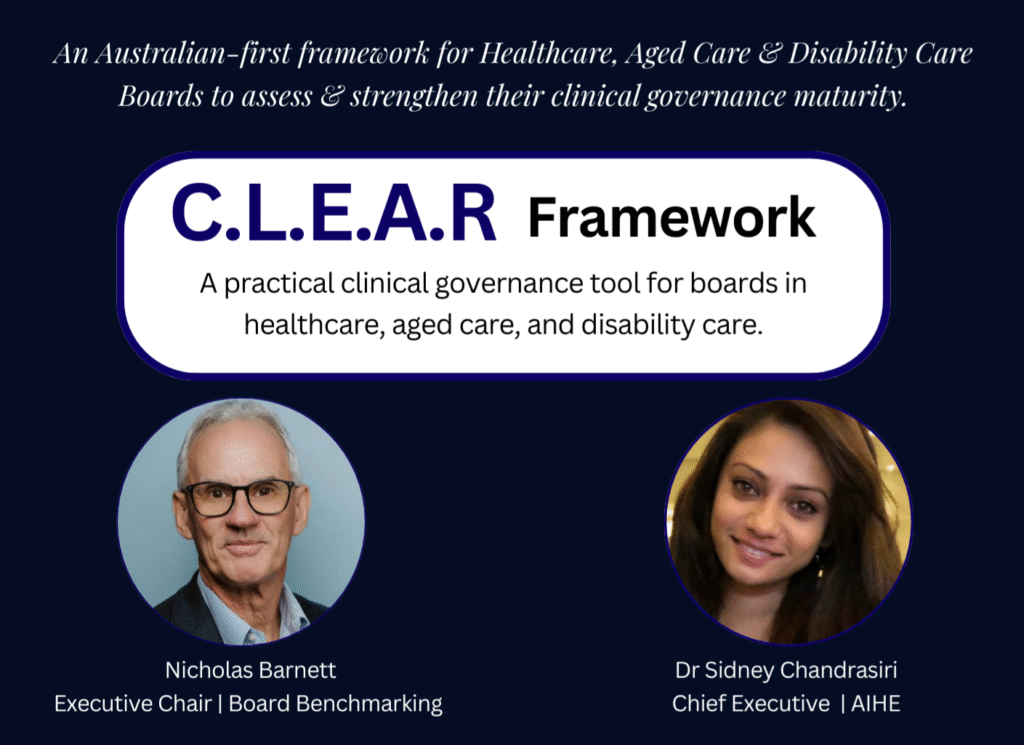
The CLEAR framework, developed by the Australian Institute of Health Executives (AIHE), Insync and Board Benchmarking, offers such a structure. Its value lies less in the acronym itself, and more in the discipline it creates: requiring boards and peak clinical governance committees to reflect not only on outcomes but also on how their governance behaviours, composition and culture influences those outcomes.
Moving from oversight by instinct, to oversight by design
Most board directors bring a wealth of experience, judgement and professional instinct. But in complex care settings, instinct alone can be misleading. A common situation is when boards may overemphasise short-term safety metrics while overlooking broader systemic risks. An example of this may include assuming that consumer engagement is “covered” because the satisfaction survey results look strong, without testing whether the voice of lived experience is influencing decision-making.
The CLEAR framework counteracts these tendencies by providing a balanced set of governance domains against which to self-assess. Committee role and composition, leadership and dynamics, excellence in quality and safety, workforce assurance, and consumer voice. This balance matters. Because a board that rates itself highly on quality oversight but poorly on workforce and consumer rights, cannot claim robust clinical governance.
For healthcare executives, this offers a different kind of value: it creates a shared language with the board. Instead of fragmented conversations about incidents or compliance, discussions can be anchored to a structured model that recognises the interdependence of workforce, clinical safety and consumer outcomes.
Why self-assessment matters more than external assurance
Healthcare leaders are no doubt very familiar with accreditation cycles, clinical audits and surveyor visits. These provide a measure of external assurance which is certainly important. But they rarely interrogate the board’s own effectiveness as a governing body. Self-assessment does.
A structured self-assessment process can surface blind spots and discrepancies in perception. For example, board directors may believe their peak committee have the right expertise, while executives may see critical capability gaps. Or the consumer voice may be assumed to be present in organisational decision-making, but is in practice it is diluted through surveys rather than via direct representation.
The act of self-assessment also shifts the mindset from “Are we compliant?” to “Are we effective?”. This shift may seem subtle, but has significant consequences. It reframes governance from being a defensive or reactive posture to a proactive one, which is not about avoiding failure, but about building resilience and anticipating the future.
The link between governance maturity and organisational performance
There is growing evidence across corporate and healthcare sectors that governance maturity correlates with organisational performance. Boards that engage critically with their own effectiveness make more balanced decisions, allocate resources more strategically, and respond faster to emerging risks.
In healthcare, aged care and disability services, this link is even more pronounced. Workforce shortages, changing consumer expectations, digital disruption, and regulatory reform are not just abstract issues. They can directly impact patient safety, service quality and community trust. A board with immature clinical governance practices risks being blindsided by these factors. Conversely, a board that regularly evaluates its clinical governance standard, using a framework like CLEAR, is better positioned to see the weak signals early, challenge assumptions, and set the tone for continuous improvement.
What makes CLEAR different
As a board director you may be wondering why you should adopt yet another framework when sector standards already exist. The answer is that CLEAR is not a replacement for standards, but it is a complement. Where standards focus on the systems and processes of care delivery, CLEAR focuses on the board’s role and effectiveness in governing them.
Some of its distinct contributions include:
- Integration of domains: CLEAR places quality, workforce and consumer rights on equal footing, preventing tunnel vision on safety metrics alone.
- Governance dynamics: It examines leadership, decision-making, and meeting culture, which are factors that are central to effectiveness, but are often ignored.
- Practical improvement cycle: It is designed for repeat use, allowing boards to track their maturity growth over time rather than treat clinical governance as a one-off compliance exercise.
- Applicability across care settings: CLEAR works equally well in hospitals, residential aged care, community health and disability organisations, giving mixed-portfolio boards a consistent lens.
For health leaders and executives, CLEAR therefore offers more than a checklist. It creates a clinical governance improvement roadmap that aligns with organisational strategy and risk management.
The opportunity for health sector boards
Healthcare boards are facing an inflection point. Regulators are tightening expectations, consumers are demanding voice and transparency, and the workforce is under chronic strain. In this environment, boards that rely on historical approaches to clinical governance will struggle to maintain legitimacy and confidence.
The opportunity here is to treat clinical governance itself as a strategic asset. By adopting structured self-assessment through CLEAR, boards can elevate the quality of their clinical governance discussions, strengthen alignment with executives, and demonstrate to regulators and communities that they are not only accountable but actively learning.
For health executives, this shift matters too. When boards engage in structured self-assessment, it automatically raises the quality of board-executive dialogue. Instead of defensive reporting, executives can engage in strategic problem-solving with board directors who are more aware of their own clincial governance strengths and limitations.
A new standard of diligence
Ultimately, the question is not whether healthcare boards should adopt frameworks like CLEAR. It is whether they can afford not to. In an era where public confidence in health and care governance is fragile, the absence of structured self-assessment is itself a risk.
CLEAR does not guarantee perfect clinical governance. But it does create the conditions for healthcare, aged care and disability care boards to govern with purpose, balance and foresight. And that may well become the defining standard of clinical governance diligence over the next decade of healthcare leadership.
To access the clinical governance self-assessment board survey that supports the CLEAR framework, please contact us at enquiries@aihexec.com.
To understand and equip yourself and your board directors with contemporary and relevant clinical governance expertise, register for our upcoming Clinical Governance for Directors 1-Day Course.